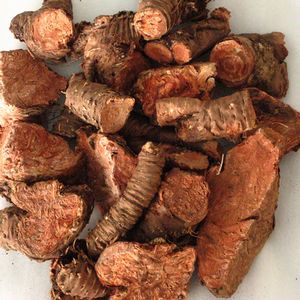
Properties: Sweet, astringent, cold
Meridans Entered:
Primary: Heart, Kidney, Liver, Spleen, Lung
Traditional Actions/Indications:
- Fortifies the Lungs and Spleen and tonifies Qi
High altitude sickness
Fatigue and sensations of weakness
- Clears Lung Heat, nourishes Lung Yin and relieves cough
Lung Heat cough: cough due to pneumonia, hematemesis, hemoptysis
Lung Yin Deficiency: tuberculosis, bronchitis
- Invigorates the Blood and transforms Stasis
Blood Stasis from traumatic injury topically
Topically for burns and scalds
- Promotes contraction
Abnormal vaginal discharge
Suggested Daily Dosage: 3-12g in decoction.
Notable Constituents:
- Rosarin
Cinnamyl alcohol glycoside only present in Rhodiola rosea, but not crenulata, believed responsible for many of the adaptogenic properties against neurodegenerative, digestive, respiratory and bone diseases (Wang et al., 2023).
- Salidroside
Glycoside of tyrosol, present in all species of rhodiola believed responsible for protection from high altitude hypoxia through maintaining the integrity of the blood brain barrier and activating several mitochondrial homeostasis mechanisms (Hou et al., 2024; Hou et al., 2023; Yan et al., 2021) and possessing neuroprotective effects by protecting neurons against apoptosis (Wang et al., 2017).
Notes:
There are many subspecies of Rhodiola. Rhodiola rosea (Mei Gua Hong Jing Tian, 玫瑰紅景天) tends to be the dominant species on the market although crenulata (Da Hua Hong Jing Tian, 大花紅景天) was the species mainly used in Chinese medicine when it was introduced to the pharmacopoeia in the 1990s and is still a common adulterant despite not containing the rosarins believed to be the principle adaptogenic component.
Appears in 1 formulae listed on this site: (click to display)
Research Links & References: (click to display)
Research Links:
Reference Notes:
Individual herb information has sourced mainly from TCM Wiki and American Dragon for basic data and then updated manually with my own notes. Zhou, Xie and Yan (2011): Encyclopedia of Traditional Chinese Medicines, Vol. 5, and A+ Medical Encyclopaedia have been used for entries not available from those sources with additional material searched for and filled in where available. Western herbs not appearing in the Chinese literature have used Ross (2010): Combining Western Herbs and Chinese Medicine: A Clinical Materia Medica, White Rabbit Institute of Healing and therapeutika.ch. Choices of which source to use or combine have been my own.
These pages are intended to assist clinicians and are not intended for self-diagnosis or treatment for which a qualified professional should be consulted. Actions and indications are taken from traditional uses and do not necessarily reflect the evidence base which should be researched independently. Dosages are for guidance only and will vary dependening on the potency of the batch and the tolerance of the individual so should be evaluated by a professional based on individual needs.