This page features notes I have found on dietary guidelines in Chinese medicine. They are based upon pattern diagnosis and designed to balance the excesses and deficiencies within our bodies.
One important factor in Chinese dietary therapy is taste and the popular teaching is that the Five Flavours each relate to the Five Zang organs based on the Five Phase (Wuxing) attributions, based on quotes from the Su Wen chs. 5 & 67 which both say:
"Wood generates sourness.
Sourness generates the Liver ...
Sourness harms the Sinews.
Acridity dominates sourness ...
Fire generates the bitterness.
Bitterness generates the Heart ...
Bitterness harms the Qi.
Saltiness dominates bitterness ...
Earth generates sweetness.
Sweetness generates the Spleen ...
Sweetness harms the Spleen.
Sourness dominates sweetness ...
Metal generates acridity.
Acridity generates the Lung ...
Acridity harms the skin and the body hair.
Bitterness dominates acridity ...
Water generates saltiness.
Saltiness generates the Kidneys ...
Saltiness harms the Blood
Sweetness dominates salty."
The assumption is often that these two sections say that their corresponding flavour nourishes that particular Zang organ and suppresses the one in its Five Phase controlling cycle. However, a careful reading reveals that sourness harms the Sinews, which are under the governance of the Liver, and acridity harms the skin and body hair, which are under the governance of the Lung, while sweetness harms the Spleen itself!
The flavours and their properties appear a few more times in the Su Wen, notably in chs. 10 and ch. 22, which reveal a more complex approach that contradicts the generally accepted attributions and reveals a deeper and more subtle system.
This system is summarised at the end of Su Wen ch. 22 with the following:
"Acridity disperses
Sourness contracts
Sweetness relaxes
Bitterness hardens
Saltiness softens"
This seems to contradict the attributions given in Su Wen 5 & 67, since the nature of the elements is that:
This is attested to earlier in the chapter, where various pieces of practical advice are given in relation to the Zangfu. The first list of applications states:
"When the Liver suffers from tensions, quickly consume sweet to relax it...
When the Heart suffers from slackening, quickly consume sour to contract it again...
When the Spleen suffers from dampness, quickly consume bitter to dry it...
When the Lung suffers from qi rising contrarily, quickly consume bitter to drain it...
When the Kidneys suffer from desiccation, quickly consume acrid to moisten them
by opening the interstices, allowing the fluids to reach the qi and penetrate."
This confuses the picture further, since they neither correspond to their traditional Five Phase properties, or the ones that traditionally control them. It makes sense if we remember that the Neijing consists of texts from a number of time periods, some of which may date to when Five Phases were represented as a cross with Earth at the centre.
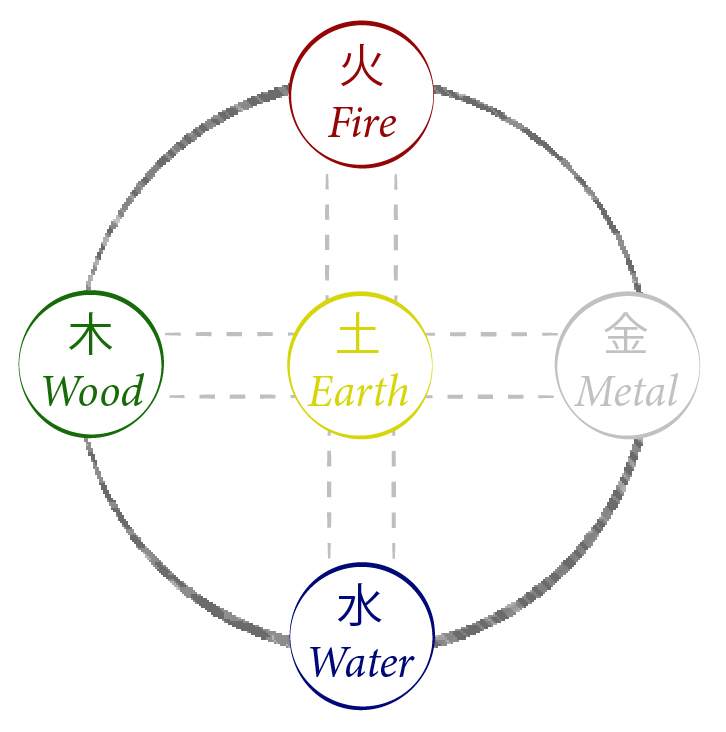
Looked at in this way, we find that this system is relying primarily on providing the flavour that is associated with the organ's child, reducing the mother by tonifying the son:
However, this only accounts for three of the Five Phases. Bitterness is assigned to drain both Metal and Earth, while sweetness drains Wood. In the next section we see the same pattern, but with another twist:
"The Liver colour is blue-green.
One should eat sweet [to treat it].
Non-glutinous rice, beef, dates, and the bitter herbs are all sweet.
The Heart colour is red.
One should eat sour [to treat it].
Small beans, dog meat, plums, and leek are all sour.
The Lung colour is white.
One should eat bitter [to treat it].
Wheat, mutton, apricots, and chives are all bitter.
The Spleen colour is yellow.
One should consume salty [to treat it].
Large beans, pork, chestnuts, and bean leaves are all salty.
The Kidney colour is black.
One should eat acrid [to treat it].
Yellow glutinous millet, chicken meat, peaches, and onions are all acrid."
Once again, sweetness is used to soften the treat the Liver / Wood, but now saltiness is used to treat diseases of the Spleen / Earth. This reveals something about the nature of the centre in this paradigm. Instead of being located between Fire and Metal, as is common in the modern tradition, the centre lies between Growing Yang / Wood and Greater Yang / Fire, and also between Growing Yin / Metal and Greater Yin Water. This is common sense: the Middle should be in between the Lesser and Greater, and be represented on both sides, since Yin and Yang must pass through a balanced point twice in their cycle. Therefore the Centre / Earth / the Spleen can be reduced by both bitter and salty flavours, and the sweet flavour can reduce Wood and soften the Liver.
By this logic, sweetness should also be able to reduce Metal, and, although it is not mentioned here, in clinical practice, honey and liquorice are brilliant medicinal foods for helping with sore throats and coughs. By the same token, if bitterness can reduce Metal, then saltiness should be able to reduce Wood. This is also omitted here but seen in clinical practice where several salty herbs like Mu Li, Shi Jue Ming, Bai Jiang Can, Ci Shi, Dai Mao and Di Long are salty and can calm Liver Wind or clear Liver Heat. However, the text opts sweetness to gently soften the Sinews of the Liver and for bitterness to reduce Lung Heat and send the Lung Qi downwards, which are also valid protocols.
Just as Su Wen 22 appears to make sense, another section, located in between these two, gives some more applications of taste that appears to confuse things:
"The Liver longs for dispersion...
Quickly consume the acrid to disperse it. Use acridity to supplement it, sourness to drain it.
The Heart longs for softness...
Quickly consume saltiness to soften it. Use saltiness to supplement it, sweetness to drain it.
The Spleen longs for relaxation...
Quickly consume sweetness to relax it. Use bitterness to drain it and sweetness to supplement it.
The Lung longs for contraction...
Quickly consume sourness to contract it. Use sourness to supplement it and acridity to drain it.
The Kidneys long for hardness...
Quickly consume bitterness to harden them. Use bitterness to supplement them and saltiness to drain them."
However, this is not a contradiction, just a different treatment strategy of using each Phases opposing pair to drain it. For the Spleen, technically any flavour will disrupt the equilibrium of the centre, but bitterness is chosen in this instance to encourage the descending motion of the digestive system. Therefore
Within this chapter we can see a different, but logical approach based on what flavours do to our bodies and how this can be used to enhance a particular Phase, or to reduce by consuming the flavour of either its opposite, or its child.
Su Wen ch. 10 presents a related set of indications, this time describing the effects of over-indulgence in particular tastes:
"If one consumes large quantities of saltiness,
then the blood vessels will congeal to become impeded and the complexion changes.
If one consumes large quantities of bitterness,
then the skin will desiccate and the body hair is plucked out.
If one consumes large quantities of acridity,
then the sinews become tense and the nails dry.
If one consumes large quantities of sourness,
then the flesh hardens and shows wrinkles and the lips peel.
If one consumes large quantities of sweetness,
then the bones will ache and the hair on the head falls off.
These are the harms resulting from the five flavours.
In this section, the harms are described as unbalancing the Five Phases. Hence:
This exactly corresponds to the ch. 22, where bitterness is the flavour used to drain excess in the Spleen, while saltiness is used elsewhere to soften hard concretions in the centre.
These basic directional forces of the flavours in Su Wen 10 are easily borne out by modern insights. Excess salt causes high blood pressure which leads to clotting events and excessive sugar intake leads to diabetes which is characterised by excessive urination (bones are governed by the Kidneys). Excessive acrid, spicy foods raise Qi upwards and can cause us to feel hot and agitated like a Liver pattern, while bitter herbs are used to drain Dampness and Heat, and can lead to dryness and damage to Spleen Qi if taken in excess.
Western herbalism often uses bitter tonics as digestives, but this may be a different way of describing the same action: by encouraging movement along the digestive tract, it is both draining and unblocking but also enhancing digestion by drying Dampness and promoting the downward motion of Stomach Qi.
Su Wen ch. 22 finishes with a summary:
Hence,
The Heart longs for bitterness,
The Lung longs for acridity.
The Liver longs for sourness.
The Spleen longs for sweetness.
The Kidneys long for saltiness."
This last statement gives exactly the same attributions of flavours as those presented in Su Wen chs. 5 and 67, except that in the light of the other quotes that have just been reviewed, the flavours actually represent their opposites, for which they yearn to restore balance. The reason that Wood generates sourness is not because it is like sourness, but because it is the opposite. When Wood is differentiated from the central equilibrium, its opposite must by necessity come into existence to maintain harmony. Suddenly, the unusual references that say that a flavour harms itself, like "sourness harms the Sinews," "sweetness harms the Spleen" and "acridity harms the skin and body hair" make sense. These are the flavours that balance those organs and excess consumption of a contracting flavour will harm the expansive properties of Wood and therefore the Sinews. "Sweetness harms the Spleen" because it has no opposite, returning everything to the centre, which will eventually cause stagnation and a lack of transformation due to nothing moving away from the equilibrium.
Furthermore, we have two options to treat an excess in any organ, a relatively gentle approach of reducing it by nourishing its child, or a direct and forceful approach to reinforce its exact opposite. The main difference seems to be that reinforcing its opposite has the potential to damage it, although all flavours have the potential to damage another, making the correct flavours to choose a matter of strategy and evaluating the patient's resources. We also have a third option of harmonising through sweetness, which explains the exceptional balancing activity of Gan Cao.
The links below give some specific dietary recommendations for each major TCM pattern of imbalance. These may not have all the subtleties of the Nei Jing discussion above, but can be useful guides to distribute for patients. Please note that you should not restrict yourself to eating only the foods on the list but use them as suggestions for what to incorporate and avoid in your diet. Other dietary plans can also be considered and incorporated into these. Where a complex pattern is diagnosed, compare the sheets for the relevant patterns and make decisions based on the weighting of the diagnoses.
Woodley Bioenergetics
90 Deane Croft Road,
Eascote, Pinner, Greater London. HA5 1SP
Tel/WhatsApp: +44 (0) 7946 174 829
Email: steve@steve-woodley.co.uk


