 |
Location Guides: |
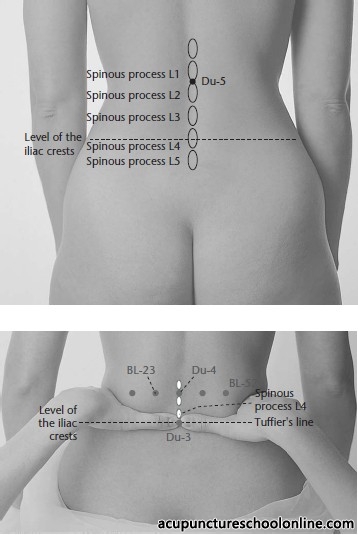
On the midline of the lower back, in the depression below the spinous process of the first lumbar vertebra (L1).
Perpendicular insertion 0.5 - 1 cun
The spinal canal lies between 1.25 and 1.75 cun deep to the skin surface, varying according to body build.
"Lie (the patient’s body) prostrate to locate it. It is needled to a depth of threefen and it is moxaed with three cones" (Huangfu Mi 皇甫謐, 3rd Century, Zhenjiu Jiayi Jing 針灸甲乙經).
Benefits the lumbar spine
Benefits the Lower Jiao
Superficial Innervation: Medial branches of dorsal rami of L1
Dermatome Segment: L1
See Montaigue, Dim Mak Locations, Taijiworld.com for explanation of effects.
Trigrams: Qian (Heaven) below, Kun (Earth) above.
Heaven within, Earth without — the light rises and the heavy sinks, so they meet in the middle. This is the perfect harmony of yin and yang, the moment of peace.
Nuclear Trigrams: Lines 2-3-4 form Dui (Lake). Lines 3-4-5 form Zhen (Thunder). Beneath the peace, there is joy (Dui) and movement (Zhen). The hidden message: peace is not static. It is alive with joy and activity.
Judgement:
泰:小往大來,吉亨。
Peace. The small departs. The great arrives. Good fortune. Success.
Peace is the moment when the creative and the receptive meet. The small departs, the great arrives. This is the time of flourishing, of success, of the marriage of Heaven and Earth. It is the golden age, the moment of perfect balance.
Lines:
| Line | Yin/Yang | Image | Literal Translation | Commentary |
|---|---|---|---|---|
| 1 | Yang | 拔茅茹,以其彙,征吉 | Pulling up the reed grass, connected by its roots. Going brings Gain. | Yang at the bottom. The beginning of peace. The yang lines are drawn upward together, like reeds connected by their roots. The whole group rises. Gain because the movement is collective and natural. |
| 2 | Yang | 包荒,用馮河,不遐遺,朋亡,得尚于中行 | Embracing the wild, crossing the river. Not neglecting the distant. Friends perish. One obtains the honour of the middle path. | Yang at 2, central and correct. The peace is expansive. It embraces even the wild and distant. But there is a cost — old friends fall away. The middle path is honoured because it is inclusive, not exclusive. |
| 3 | Yang | 無平不陂,無往不復。艱貞無咎。勿恤其孚,于食有福 | No plain that does not become a slope. No going that does not return. Perseverance in hardship brings no trouble. Do not worry about sincerity. In food there is blessing. | The threshold. The peak of peace. The warning: everything that rises must fall. The plain becomes a slope. But if you persevere correctly, there is no trouble. The blessing is in the simple nourishment of the present. |
| 4 | Yin | 翩翩,不富以其鄰,不戒以孚 | Fluttering, not wealthy but with neighbours. Not warned but sincere. | Yin at 4. The peace is beginning to turn. The yin lines are fluttering down, drawn by the yang below. They are not wealthy, but they have neighbours. They are not warned, but they are sincere. The turning is gentle, not catastrophic. |
| 5 | Yin | 帝乙歸妹,以祉元吉 | The emperor Yi gives his sister in marriage. Supreme Gain. | Yin at 5, central and correct. The marriage of Heaven and Earth. The emperor gives his sister to the yang below. This is the moment of perfect harmony. Supreme Gain because the union is complete and correct. |
| 6 | Yin | 城復于隍,勿用師。自邑告命,貞吝 | The wall falls back into the moat. Do not use the army. Proclaim the command from your own city. Perseverance brings Regret. | Yin at the top. The peace has ended. The wall has fallen. The army cannot save it. The command must come from within. Regret because the turning is now irreversible — the stagnation has begun. |
Image:
天地交,泰。后以財成天地之道,輔相天地之宜,以左右民。
Heaven and Earth unite: Tai. Thus the ruler divides and completes the way of Heaven and Earth, assists and supports the suitability of Heaven and Earth, and thereby guides the people.
The image is of Heaven and Earth meeting — the creative and the receptive in harmony. The ruler divides and completes (財成, cai cheng) the way of Heaven and Earth. He does not impose his own order; he assists the natural order. He guides the people (左右民, zuo you min) by supporting what is already flourishing.
Acupuncture Point Connections:
This hexagram is shared Jiuwei Ren-15, the front Mu point of the Ren Mai.
Hexagram attributions are my own with an explanation given in the glossary.
Translations are my own, assisted by DSeek and compared to Richard Rutt's interpretion (2002).
This point is also on the 3rd trajectory of the Chong mai connecting the Chong with the Du for Invigorating Yang in cases of Bi Obstruction due to Blood Stagnation (Yuen, 2005, The Extraordinary Vessels).
From Yuen's school, this point along with Jianli Ren-11, relate to the Third Level of Manifestation of the Soul (Po).
The third Po is connected to early adulthood and the Spleen - Kidney dynamic, the emergence of moral judgement and relationship between social conditioning and personal responsibility. An obstruction at this level results in Peter Pan syndrome, a person who refuses to take responsibility and seeks only to dream, escape and play.
Treatment typically involves the Po Activation points Changqiang Du-1 and Jiuwei Ren-15 which are the Luo of the Ren and Du channels, accessing emotion at the level of the Jing, followed by the points associated with the particular level of blockage.
Berardinis & Navarra (2017). The succession of Po in the ladder of life. https://www.acupuncturesida.com/The-succession-of-Po-in-the-ladder-of-life.aspx
The Illustration of Time in the Principles of the Innate Disposition and the Lifespan (Xingming Guizhi, 性命圭旨) describes the movement of prenantal Qi through the microcosmic orbit in terms of the I Ching Hexagrams and the twelve Earthly Branches. It says that:
The prenatal Qi of human beings follows the course of the day:
during the Zi (11 pm - 1 am), the Fu (Turning Back, ䷗) Qi arrives at Caudal Defile (GV 1);
during the Chou (1-3 am), the Lin (Approaching, ䷒) Qi arrives at Kidney Hall [maybe GV 4];
during the Yin (3-5 am), the Tai (Advance, ䷊) Qi arrives at the Mystic Pivot [maybe GV 5 based on name, or GV 7 based on location];
during the Mao (5-7 am), the Dazhuang (Great Strength, ䷡) Qi arrives at the Spinal Handle [possibly GV 10 or GV 11];
during the Chen (7-9 am), the Guai (Eliminating, ䷪) Qi arrives at the Kiln Path (GV 13);
during the Si (9-11 am), the Qian (Initiating, ䷀) Qi arrives at the Jade Pillow (Bl 9 [or GV 17]);
during the Wu (11 am -1 pm), the Gou (Encountering, ䷫) Qi arrives at the Mud Pill (GV 20);
during the Wei (1-3 pm), the Dun (Retreating, ䷠) Qi arrives at Hall of Brilliance (GV 23);
during the Shen (3-5 pm), the Pi (Hindrance, ䷋) Qi arrives at the Centre of the Chest (CV 17);
during the You (5-7 pm), the Guan (Watching, ䷓) Qi arrives at the Central Venter (CV 12);
during the Xu (7-9 pm), the Bo (Falling Away, ䷖) Qi arrives at Spirit Gate (CV 8);
during the Hai (9-11 pm), the Kun (Responding, ䷁) Qi returns to the Sea of Qi (CV 6).
(translated in Liu Lihong, 2019, Classical Chinese Medicine).
The "Mystic Pivot" is not given a precise location or standard acupuncture point name but this name is given in Wade-Giles Romanisation as one of the centers of the grand circulation by Chang (2011, Creativity and Taoism, p. 175) and Xuanshu is a homonym for 玄樞 "Mysterious Pivot". This is also a name given to the first star in the Big Dipper constellation which is of great importance to Daoists.
Based on some considerations of the hexagram associations given here, the attributions of ䷁ and ䷀ to Huiyin Ren-1 and Baihui Du-20, and a desire to make ䷊ and ䷋ oppose one another at the centre of the body, it would seem that these attributions are where the Qi of a particular hexagram start, and finish at the start of the next, similar to how an hour continues until the next begins. Hence ䷊ governs the region between Xuanshu Du-5 or Zhongshu Du-7 and Lingtai Du-10 or Shendao Du-11.
The hexagram associated with this point represents the advance of Yang and is associated with the Earthly Branch of Yin, 3 - 5 am, and the Lung. This places Metal in the East and may have some bearing on the alchemical practice of extracting White Lead (True Yang) from Black Lead (Water), as a reference to returning to the prenatal cycle. This is further suggested by the fact that this hexagram is exactly equivalent in its composition to Lesser Yin (⚍).
Based on the Hexagram attributions of the Antique Points, this would correspond to Jiuwei Ren-15 which shares the Hexagram Tai (Advance, ䷊). Its association with the Earthly Branch of the Lung strengthens this association with the area under the diaphragm. This connection with the Luo of the Ren Mai connects it to the Uterus Vessel, the Bao Mai, which is of utmost importance in Neidan practice for the formation of the Spiritual Embryo. Its association with the Earthly Branch of the Lung which represents spring and new birth strengthens this association. Along with Shanzhong Ren-17, which is its complementary opposite ䷋, these two represent the process of forming the Spiritual Embryo in the centre out of the purified Yin and Yang. This point particularly emphasises their mingling due to Yang being below Yin, while Shanzhong Ren-17, represented by ䷋ suggests the earlier step of their separation.
The star Thuban is known as the "Right Pivot" (右樞 Youshu) in Chinese astrology. From 3942 - 1793 BC, throughout the legendary emperors reign, the neotlithic Majiayao culture when acupuncture theories were developed (3300 - 2000 BC; Turk, 2015) and the Xia Dynasty (approx 2200-1600 BC), this would have been the Pole Star, making it likely that it would have a name like Suspended Pivot until it was displaced by κ-Draconis (少尉 Shaowei, "Second Lieutenant"). However, due to this star being too dim, the position of Pole Star was given to Kochab (帝星 Huang Xing, "Emperor Star").
In Tibetan medicine:
Edelweiss flowers are burnt in cones like moxa over crushed garlic at this point as a kidney point to treat all manner of kidney diseases (Bradley, 2000: Principles of Tibetan Medicine)
Basic information on location, needle depth, TCM actions, indications and combinations is taken from Deadman et al (2001): A Manual of Acupuncture with additional anatomical information researched by reference to Gray's Anatomy (38th Ed., 1995) unless otherwise referenced. Images were found on acupunctureschoolonline.com and can be traced back to Claudia Focks (2008) Atlas of Acupuncture originally. I cannot claim any credit or rights over them. Other sources should be quoted in the text.
For some of the more unusual terms I have created a glossary here
Woodley Bioenergetics
90 Deane Croft Road,
Eascote, Pinner, Greater London. HA5 1SP
Tel/WhatsApp: +44 (0) 7946 174 829
Email: steve@steve-woodley.co.uk


