Properties: Sweet, slightly bitter, warm
Meridans Entered:
Primary: Spleen, Lung and Heart
Traditional Actions/Indications:
- Powerfully tonifies Yuan Qi and Yang
Extreme collapse of Qi or abandoned conditions that manifest in shallow breathing, shortness of breath, cold limbs, profuse sweating and an almost imperceptible pulse (after blood loss, overly profuse sweating or other problems related to severe fluid loss - it can be used alone in these emergencies)
Collapse of Yang
- Tonifies Spleen and Stomach Qi
Lethargy, anorexia, chest and abdominal distention, chronic diarrhoea and, in severe cases, prolapse of the Stomach, uterus or rectum
- Tonifies Lung Qi
Lung Qi Deficiency with wheezing, shortness of breath and labored breathing on exertion
- Generates Body Fluids and stops thirst
Wasting and thirsting disorder (消渴 Xiao Ke) and high fevers with profuse sweating which injures Qi and fluids
- Tonifies Heart Qi and calms the Spirit
Heart Qi and Blood Deficiency with palpitations, anxiety, insomnia, forgetfulness and restlessness
- Treats impotence
With Kidney Yang tonics for impotence
- Tonifies Qi in Deficiency patients with Exterior conditions
Exterior disorder with Interior Deficiency
Suggested Daily Dosage: 3-9g in decoction.
Cautions: Antagonizing to Li Lu. Caution in hot disorders and Blood or Yin deficiency where untreated Ren Shen or Yang Xi Shen are more appropriate.
Interactions:
- Phenelzine: May cause sleeplessness, tremor, headache.
- Anticoagulants: May increase effect of warfarin, heparin and NSAIDs. Mechanisms are still being determined.
- Alcohol: May break down alcohol faster.
- Stimulants, including caffeine: May have additive effect causing palpitations and high blood pressure.
- Antidiabetic drugs: May have additive effect.
- Immunosuppressants: Can boost the immune system, decreasing the effect of these drugs.
- MAOIs: Might cause side effects such as anxiousness, headache, restlessness, and insomnia.
- Medications changes by Cytochrome P450 2D6: May decrease how slowly these medications are broken down, increase their effect and side effects. For a complete list see the Cytochrome P450 Substrates.
Notes:
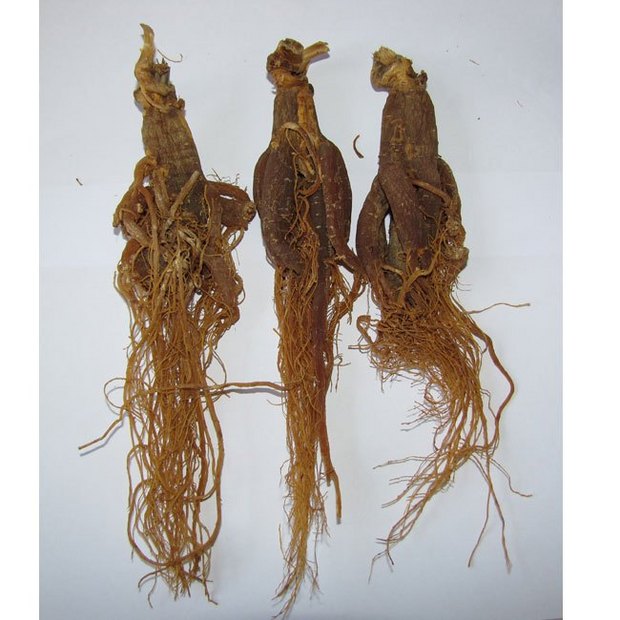
This is Ren Shen that has been treated by steaming which makes it hotter and better suited for tonifying Yang.
--------------------------------------
Analysis of the ancient script forms of 參 Shen suggest it is simplified from 曑 (晶 -> 厽) making an ideogrammic compound of 晶 ("stars") + 光 ("light; brightness") + 彡 ("light rays") meaning the Three Stars astrological mansion (referring to the three stars of Orion's belt in western astronomy at the centre of this constellation). 彡 also acts as a phonetic component. Its main meaning is "joining, merging, being a part of" suggesting the three stars making up a single constellation.
光 may also be interpreted as 卩 ("kneeling person"), representing someone looking at the shining stars above him or be the original character for 簪 a hairpin and thus someone with a ceremonial hat of stars.
參 also appears in the title of the famous alchemical text 參同契 Cantong Qi translated as The Seal of the Unity of the Three, or Joining as One with Unity, with 參 playing on the double meaning as "three" and "joined as one" where it refers to the unity of the cosmology of the Yi Jing, Daoism and internal alchemy (Pregradio, 2011, Seal of the Unity of the Three, p. 3).
These all suggest a great reverence for these herbs, which crosses into the cosmological, religious and self-cultivation realms, while also suggesting a completeness of these herbs in themselves. Herbs with 參 in their name may be used individually, without needing a formula to complement them.
Does not appear in any formulae listed on this site
Research Links & References: (click to display)
Research Links:
Reference Notes:
Individual herb information has sourced mainly from TCM Wiki and American Dragon for basic data and then updated manually with my own notes. Zhou, Xie and Yan (2011): Encyclopedia of Traditional Chinese Medicines, Vol. 5, and A+ Medical Encyclopaedia have been used for entries not available from those sources with additional material searched for and filled in where available. Western herbs not appearing in the Chinese literature have used Ross (2010): Combining Western Herbs and Chinese Medicine: A Clinical Materia Medica, White Rabbit Institute of Healing and therapeutika.ch. Choices of which source to use or combine have been my own.
These pages are intended to assist clinicians and are not intended for self-diagnosis or treatment for which a qualified professional should be consulted. Actions and indications are taken from traditional uses and do not necessarily reflect the evidence base which should be researched independently. Dosages are for guidance only and will vary dependening on the potency of the batch and the tolerance of the individual so should be evaluated by a professional based on individual needs.