Properties: Cool, acrid, bitter, slightly sweet
Meridans Entered:
Primary: Lung
Traditional Actions/Indications:
- Clear Retained Pathogens, tonify and regulate Wei Qi
Recurring respiratory infection, especially in weakened people as short term prevention, early stage of infection and early post-infection recovery
- Clear Wind-Heat
Acute respiratory infection, common cold or flu and allergic rhinitis.
- Clear Lung Heat and transform Phlegm-Heat
Acute bronchitis, pleurisy or pneumonia with fever, chronic sinusitis or bronchitis
- Clear Toxic Heat
Infections, boils, abscesses and leukorrhoea.
As adjunct to chemotherapy.
- Clear Bladder Damp-Heat
Acute or recurring urinary infection.
Suggested Daily Dosage: 3g in decoction or as powder as preventative, or 6-15g for acute conditions for no more than 3 days.
Cautions: May cause allergic reaction in short term, or immunosuppression if used long term (> 8 weeks).
Interactions:
- Immunosuppressants: may cause decreased effect, although long term use may cause immunosuppression.
- Recommended to stop 2 weeks before surgery due to immunomodulatory although data is scarce (Ang-Lee, Moss & Yuan, 2001; Yilmaz & Çifci, 2018).
Notes:
Actions and Indications are taken from Ross (2010), Combining Western Herbs and Chinese Medicine.
Medical News Today says: "Native American Indians did not commonly use echinacea for the treatment or prevention of colds. Some, like the Kiowa and the Cheyenne, used it for sore throats and coughs, while the Pawnee said it was useful for headaches. The Lakhota said it was an excellent painkiller."
----------------------------------------
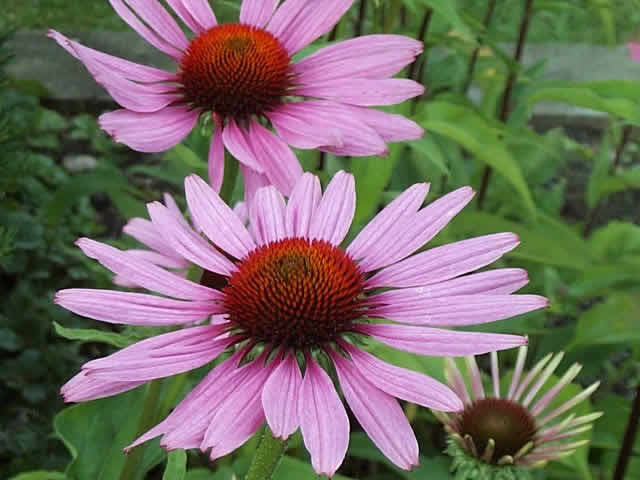
Echinacea purpurea is the most commonly used variety and the easiest to grow but angustifolia ( 狭叶紫松果菊 / Xia Ye Zi Song Guo Ju / Narrow Leaf Purple Pine Cone Chrysanthemum) was the type most probably used by the native Americans and purpurea selected because its abundance. This means many herbalists find angustifolia better and works at lower dosages than purpurea although there is no consensus (Combs, n.d.) and the American Botanical Council (2016) currently only approve Purpurea flower and Pallida root due to lack of trials on angustifolia.
Does not appear in any formulae listed on this site
Research Links & References: (click to display)
Research Links:
Reference Notes:
Individual herb information has sourced mainly from TCM Wiki and American Dragon for basic data and then updated manually with my own notes. Zhou, Xie and Yan (2011): Encyclopedia of Traditional Chinese Medicines, Vol. 5, and A+ Medical Encyclopaedia have been used for entries not available from those sources with additional material searched for and filled in where available. Western herbs not appearing in the Chinese literature have used Ross (2010): Combining Western Herbs and Chinese Medicine: A Clinical Materia Medica, White Rabbit Institute of Healing and therapeutika.ch. Choices of which source to use or combine have been my own.
These pages are intended to assist clinicians and are not intended for self-diagnosis or treatment for which a qualified professional should be consulted. Actions and indications are taken from traditional uses and do not necessarily reflect the evidence base which should be researched independently. Dosages are for guidance only and will vary dependening on the potency of the batch and the tolerance of the individual so should be evaluated by a professional based on individual needs.