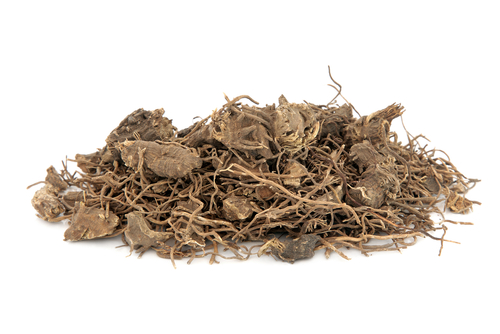
Properties: Pungent, slightly sweet, slightly bitter, slightly cold
Meridans Entered:
Primary: Kidney, Heart
Suggested Daily Dosage: 3-10g in decoction.
Cautions: There have been reports of liver toxicity from taking this herb although reviews of the evidence have failed to support a direct link and most likely point to adulteration. However, caution should be exercised in untraceable sources as adulteration may be common.
Notes:
Traditionally it has also been used among native Americans for musculoskeletal pain, fever, cough, pneumonia, sluggish labour, and menstrual irregularities, while European settlers used it as a tonic to support women’s reproductive health (National Institute of Health, 2020).
There has been some considerable confusion with the nomenclature of this herb, with many Chinese imports of incorrect species being sold as Black Cohosh and being linked to reports of liver damage. This includes several species that share the same genus of Actaea or Cimicifuga or have the Chinese equivalent common name of Black Cohosh (Hei Sheng Ma, Vernonia scabra) (Foster, 2013). However, tracing the hepatotoxic constituents has proven difficult and it may not even be the species that causes the problem but the use of unprocessed fibrous roots which show a hepatotoxic potential (Yu et al., 2022).
Woodley Bioenergetics
90 Deane Croft Road,
Eascote, Pinner, Greater London. HA5 1SP
Tel/WhatsApp: +44 (0) 7946 174 829
Email: steve@steve-woodley.co.uk


